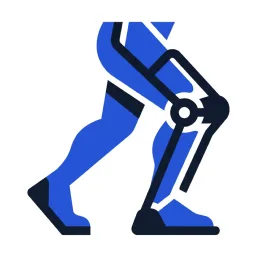
An exoskeleton is a wearable frame, worn outside the body, that supports or assists the movement of a joint such as the hip, knee, back or shoulder. Powered models use motors, sensors and a battery to add force at the right moment; passive models use springs or locking struts to store energy and give it back. In the US you can order one for walking and hiking from $889 (Dnsys X1 Carbon, price checked Oct 1, 2026; the $689 X1 Lite was out of stock on Oct 8), while medical and military models are not sold to the public.
The word comes from biology. An exoskeleton is the hard outer shell of an insect or a crab (“exo” means outside): a skeleton on the outside of the body. The machines borrowed the idea, and the name stuck.
What Is an Exoskeleton? A Definition in Plain Words
Three things make a device an exoskeleton, and they help you sort the real ones from the gadgets:
- It is worn on the body, strapped at the waist, thighs, calves, chest or arms, and it moves with you.
- It works alongside a joint. Its own hinge sits next to your hip, knee or shoulder and turns with it. That is why every product is described by the joint it assists.
- It changes the load on your muscles. A powered model adds force; a passive model redistributes or returns your own effort. A brace that only holds a joint still, or a cane, does not do this.
For medical devices, US law gives a precise definition. The Food and Drug Administration (FDA) regulation 21 CFR 890.3480 describes a powered lower extremity exoskeleton as a prescription device made of “an external, powered, motorized orthosis” placed over paralyzed or weakened limbs, and puts it in Class II (special controls). The consumer models sold online fall outside that definition: they are sold for recreation, with no prescription and no FDA clearance.
You will also see the same products called an “exo suit”, an “exoskeleton suit”, “robotic legs” or a “wearable robot”. These are marketing names. What counts is the joint, the power source and the use.
The 4 Families of Exoskeletons, With US Prices and Real Examples
“Exoskeleton” covers four very different markets. Mixing them up is the most common source of confusion, especially on price:
| Family | What it does | Who buys it | Typical price | Real example |
|---|---|---|---|---|
| 🥾 Consumer (walking, hiking, sport) | A motor at the hip or knee eases walking and climbing | Individuals, online | $689 to $2,299 (US stores, Oct 1, 2026) | Hypershell X Ultra, $1,399 |
| 🏭 Industrial (work) | Supports the back, shoulders or legs during lifting, overhead work or long standing | Employers, often on quote | Mostly quote only; the noonee Chairless Chair 2.0 lists $2,617 (Oct 5, 2026) | noonee Chairless Chair 2.0, a wearable seat |
| 🏥 Medical | Helps people with paralysis or weakness stand and walk, usually in a clinic | Clinics and health systems, on prescription | Tens of thousands of dollars | ReWalk, the first device the FDA classified as a powered exoskeleton, in 2014 |
| 🎖️ Military | Research on carrying loads and reducing fatigue | Governments, through research programs | No price: there is no market | TALOS, a US Special Operations Command program (2013 to 2019) that ended at the prototype stage |
- Consumer models are the only ones you can order online. Nearly all assist the hip; the Dnsys Z1 assists the knee, and the Hypershell Halo motorizes both (preorder, ships late November 2026). What you can buy is mapped in our consumer exoskeleton guide.
- Industrial models are mostly passive and bought by employers after a workstation assessment: see our passive exoskeleton page. Two back-support models are also sold to individuals at a posted price: see our back exoskeleton guide.
- Medical models are prescribed and supervised, used with a care team. On the payment side, Medicare’s 2024 home health final rule classifies certain exoskeleton-type devices as braces. The path starts with a physician and a physical therapist, not a store.
- Military models are research, not products. TALOS ran from 2013 to 2019 without a suit being fielded; the figures you see online are program budgets, not price tags. What was tested, and what exists in 2026: our military exoskeleton page.
How Does a Powered Exoskeleton Work? Step by Step
Take the most common consumer type, a powered hip exoskeleton such as the Hypershell X Ultra (5.5 lb with its battery). Here is what happens at every step you take:
- You strap it on. A belt goes around your waist, the battery sits at the back, and an arm runs down each thigh to a cuff. A motor sits next to each hip joint.
- Sensors read your stride. Motion sensors called IMUs (inertial measurement units, the same kind of chip that tells your phone which way is up) track the angle and speed of each thigh, continuously.
- Software recognizes what you are doing. Walking on the flat, climbing, taking stairs, going downhill: Ascentiz lists 16 recognized movements on the H Ultra, and Hypershell offers up to 12 assist modes on the X Ultra.
- The motor adds torque at the right moment. As your leg swings forward or pushes back, the motor turns the thigh arm in the same direction. Timing matters as much as power: a push at the wrong moment works against you, which is why the software is half the product.
- You set the level, the battery sets the limit. An app sets the intensity. More assist means less range: Hypershell rates the battery of its 800 W models at 10.9 miles (17.5 km), yet at 70% assist with a loaded pack, one battery lasts about 5 miles (8 km).
A passive exoskeleton skips steps 2 to 5: a spring or a strut stores energy when you bend and releases it when you straighten, with no sensor and no choice of timing. What is inside a powered model, part by part, and how to read its spec sheet is on our powered exoskeleton page. If you are hesitating between the two, our active vs passive guide settles it.
Exoskeleton vs Exosuit vs Orthosis: What Is the Difference?
Three words that overlap, and that brands use loosely. Here is how they differ:
| Exoskeleton | Exosuit | Orthosis (brace) | |
|---|---|---|---|
| Structure | Rigid frame (carbon fiber, aluminum) with hinges at the joints | Textile, straps and cables, no rigid frame | A rigid or soft support around one joint |
| Powered? | Powered or passive | Research and clinical versions use motors that pull on cables | Usually not; a powered orthosis is what the FDA calls a medical exoskeleton |
| Main job | Add force or redistribute the load | Assist with less weight and bulk, like clothing | Hold, align or protect a joint |
| Example | Hypershell X Carbon | The Harvard Wyss Institute soft exosuit, licensed as the ReWalk ReStore for clinics working with stroke survivors | A hinged knee brace |
| Who buys it | Individuals, employers, clinics | Mostly clinics and research labs | Individuals, often on medical advice |
Three practical consequences. First, when a product page says “exo suit”, it is almost always a rigid exoskeleton. Second, the soft exosuit is real but clinical: the Wyss Institute reports that the ReStore received FDA clearance for sale to US clinical centers, for use with stroke survivors. Third, a $50 knee brace and a $1,299 powered knee exoskeleton are not two versions of the same thing: one holds the joint, the other adds force to it (see our knee exoskeleton guide).
Exoskeleton Myths vs Facts
Science fiction did a lot for exoskeletons, and a lot against clear thinking about them. The six beliefs we see most often:
| Myth | Fact |
|---|---|
| “It turns you into Iron Man.” | Consumer models assist walking at the hip or knee, with 500 W to 1,520 W of peak motor power across the models we track (brand figures). They are designed to reduce the effort of walking, not to add strength to your arms or let you lift a car. |
| “It walks for you.” | You still walk, carry your own weight and keep your balance. The device adds a push when you move. It does not hold your balance or prevent falls. |
| “The brand’s percentage is what I will get.” | A review of lab studies (Sawicki and colleagues, 2020) found twelve exoskeletons that made level walking cheaper in energy, by 3.3% to 19.8%, and notes that none did better than walking without a device until 2013. We have not found an independent published study of the consumer models sold in the US, so their percentages remain brand claims. |
| “An exoskeleton is a medical device.” | Only medical models are: Class II prescription devices under FDA rules. The consumer models you buy online are recreation products, with no FDA clearance. |
| “Passive exoskeletons do nothing.” | In lab studies of lifting, passive back supports measurably reduce the work of the back muscles. Their limit is different: they cannot add energy. Details on our passive exoskeleton page. |
| “Only the military has real ones.” | The military programs stayed at the prototype stage, while consumer models ship today from US warehouses, from $889 (Oct 1, 2026). |
Where to go next depends on why you came. To see what a private buyer can buy, read our consumer exoskeleton guide. To pick a model, start with how to choose an exoskeleton, then our ranking of the best exoskeletons.
Questions people ask about exoskeletons
What is an exo suit?
“Exo suit” (or exosuit) has two meanings. In everyday marketing, it is just another name for an exoskeleton, rigid frame included. In research and clinics, an exosuit is a soft, textile device with cables and no rigid frame, such as the soft exosuit developed at Harvard’s Wyss Institute. The consumer products sold online are rigid exoskeletons.
Do real-life exoskeletons exist?
Yes. Medical exoskeletons have been regulated by the FDA since 2014, employers use work exoskeletons, and consumer hip models ship from US warehouses today, from $889 (Oct 1, 2026). What does not exist is the full-body suit of the movies: real devices assist one or two joints.
What does "exoskeletal" mean?
In biology, exoskeletal describes a hard outer skeleton, like the shell of an insect, a crab or a lobster, as opposed to our internal skeleton. Engineers borrowed the word for wearable frames that sit outside the body.
How much does an exoskeleton cost?
It depends on the family: $689 to $2,299 for a consumer model in a US brand store (Oct 1, 2026), a quote for most work models, and tens of thousands of dollars for a medical device. Our exoskeleton price guide breaks it down.
Who should not use an exoskeleton?
Consumer models assume you can walk on your own and keep your balance. If you have balance problems, a recent injury, a heart condition or any doubt, ask your doctor or physical therapist first. The device assists your effort; it does not replace medical care.

Jean Messina
Comparative analysis of exoskeletons and mobility assistance
How we review
- Hands-on at trade shows and in stores, cross-checked with published tests and real user feedback.
- Verified specifications from several sources, with data normalized for easy comparison.
- No test bench: the spec sheet figures are the manufacturer’s.
- Prices and availability tracked regularly, rankings continuously updated.