Which exoskeleton should you buy when you know nothing about them? Relax: it is simpler than it looks. Behind the spec sheets and the watts, the choice comes down to four short questions: what it is for, which joint needs the assist, active or passive, and what budget. Answer them in order and the right model almost picks itself. That is the path this guide walks you through, without jargon.
Step 1: What Is It For? The Use Decides Everything
First question, and the only truly decisive one: what do you expect from the device? An exoskeleton is not a universal gadget, it is a tool built for a use. There are five, and you will recognize yourself in one of them:
- Hiking and sport: the core of the consumer market. The device pushes your legs at each step, and you feel the difference most on climbs and over distance.
- Everyday walking: the same family of devices, set to a gentle level. Strolls, dog walks, trips on foot that feel easier.
- Cycling and mixed activities: some recent models, like the Halo, are designed to assist pedaling too, according to Hypershell.
- Physical work: lifting, repetitive motions, arms overhead. A different family of products, bought by employers.
- Health and loss of mobility: here you leave the world of online shopping. A health professional’s assessment comes before any choice of equipment.
For the three consumer uses, here is where we would start:
| Your use | Our pick | Why this one |
|---|---|---|
| 🥾 Hiking and sport | Hypershell X Ultra | Two 30 km (18.6 mi) batteries in the box and 1,000 W of peak power; our top score, 9.6 out of 10 |
| 🚶 Everyday walking | Hypershell X Carbon | $400 less than the X Ultra, with two batteries in the box and 10 assist modes |
| 🚴 Cycling and mixed activities | Hypershell Halo | Four coordinated motors on hip and knee, and Hypershell says it can assist pedaling; a preorder that ships late November 2026 |
Found your use? Then the rest goes fast, because each use points to a joint.
Step 2: Which Joint Needs the Assist?
This question surprises beginners: an exoskeleton does not assist “the body”, it assists ONE joint. The good news is that the choice is simple:
- The hip, for most buyers. The hip does a lot of the work in walking and climbing, so assisting it lightens every step. Nearly all consumer models work here.
- The knee, for descents and stairs. The knee mostly absorbs rather than propels. If descents are what bother you, look at the Dnsys Z1 or at the Halo, which motorizes hip and knee together. Persistent knee pain is a question for your doctor or physical therapist first.
- The back and shoulders, for work. Lifting boxes, drilling overhead: this is the territory of professional exoskeletons, which we do not compare here.
Step 3: Active or Passive? The Real Difference, Explained Simply
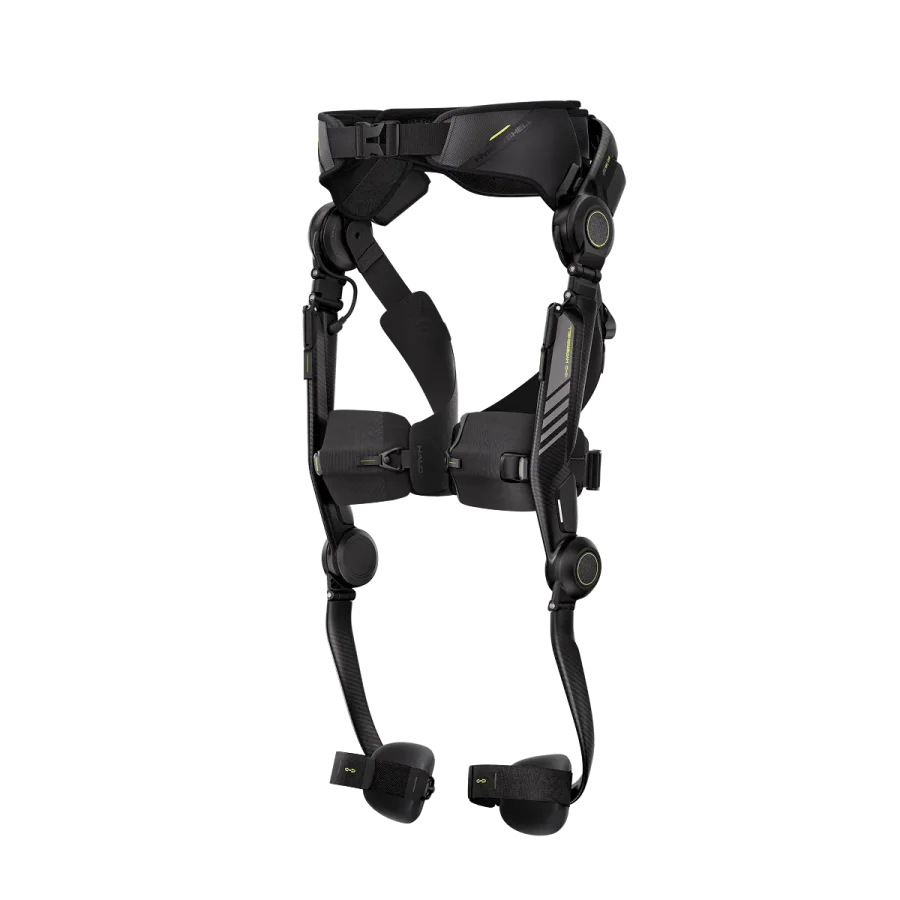
You will see these two words everywhere, so let us settle them once and for all. An active exoskeleton has motors and a battery: it adds energy to your movement, the way an e-bike does for pedaling. A passive one has no motor and no battery: springs store the energy of one movement and give it back to the next. The match, point by point:
| Active (motors) | Passive (springs) | |
|---|---|---|
| Real push you feel | Yes, adjustable | Light at best |
| Adjustable in an app | Yes | No |
| Nothing to recharge | Battery to manage | Never |
| Entry price | From $689 | Usually lower |
| Reliable consumer options | Established brands | Few proven options for walking |
Our advice boils down to this: for walking and hiking, go with an active model from an established brand. At work, on the other hand, passive is a proven category in its own right.
Step 4: What Budget Should You Plan?
Let us talk money, simply. On the consumer side, three tiers structure the whole market, and they match three profiles (US store prices checked Oct 1, 2026):
| Budget | What you get | Who it is for |
|---|---|---|
| 💵 $689 to $999 | Entry-level powered models: Dnsys X1 (from $689) and Hypershell X Carbon ($999, two batteries) | Trying one without overspending |
| 💵 $1,199 to $1,499 | The core of the range: AstroShell Alpha 1, Ascentiz H Pro, Hypershell X Ultra | Regular walkers and hikers |
| 💵 $1,699 to $2,299 | The top end: Ascentiz H Ultra, Hypershell X Ultra S, Hypershell Halo (preorder) | Big climbs, a motorized knee, the latest technology |
Looking below $500? Be careful: among the models we compare, the cheapest powered hip exoskeleton costs $689. A much lower price usually means a different product, often a passive brace, so look for a motor and a battery on the spec sheet. Two older Hypershell models, the X Pro and the X Go, were not available in the US store on Oct 1, 2026, so we leave them out of this guide. For the full price picture, from consumer models to medical devices, see our exoskeleton price guide.
Between Two Similar Models: The 4 Criteria That Break the Tie
Torn between two models in the same tier? Here is what matters most in real use, in the order we check it:
- Real-world range, not the brochure’s: it shrinks with cold weather, steep climbs and a high assist level. Our scoring grid counts it as its own criterion.
- Weight and comfort: 4.9 lb (2.2 kg) or 5.7 lb (2.6 kg) on your hips does not feel the same at hour five. Check the fit range too (waist and thigh).
- Warranty and support: a motorized device can break, so a clear warranty and a support team you can reach are worth more than a $50 saving.
- The app: it is what sets the assist. A clear app in English changes everything, especially if you are not tech-savvy.
Our pick for each criterion, with the fact that backs it:
| Criterion | Our pick | Why this one |
|---|---|---|
| 🔋 Real-world range | Hypershell X Ultra | Two 30 km (18.6 mi) batteries, 60 km (37.3 mi) in the box, and 10 out of 10 on real-world range in our grid |
| ⚖️ Weight and comfort | Dnsys X1 | 4.9 lb (2.2 kg) with the battery and 3.5 lb (1.6 kg) without, the lightest hip model we compare |
| 🛡️ Warranty and support | Hypershell X Carbon | 9.5 out of 10 on warranty and support in our grid, like every Hypershell model; Dnsys, Ascentiz and AstroShell score 7 |
| 📱 The app | Hypershell X Ultra | 12 assist modes, including snow and dune terrain modes, in an iOS and Android app |
This is exactly the grid behind our comparison of the best exoskeletons: to see every model face to face, with scores and dated prices, open that page next. Our methodology explains how we score.
Who Is an Exoskeleton For? The 5 Typical Profiles
Even simpler than the steps: recognize yourself in one of these portraits and follow its link.
The hiker who wants to go farther (or get back to long outings)
From the weekend walker to the long-distance hiker, this is the core audience: more miles, more climbing, less fatigue. A hiker whose outings are getting shorter may find the assist useful too. Start with our hiking ranking and the X Ultra review, our top pick.
The older adult who wants to keep walking
Daily walks, errands, a long afternoon on your feet: the assist is designed to make the effort feel lighter. Talk to your doctor or physical therapist first, then read our walking exoskeleton guide.
The physical worker (and the employer)
Lifting, construction, arms overhead all day: the logic changes. Buying goes through a quote, teams need training, and the budget is counted in thousands of dollars per unit. Our price guide covers this segment; we do not compare work models here.
The technology enthusiast
Someone who wants the most advanced product of the moment, for the object as much as the use. Look at the Hypershell Halo: the only consumer model we compare that motorizes hip and knee, with a built-in voice assistant according to Hypershell. It is a top-end product at a top-end price, $2,299 on Oct 1, 2026, and it ships in late November 2026. Since it has not shipped yet, weigh the brand’s claims with extra care.
The person with reduced mobility
Lasting pain, a medical condition, uncertain balance: stop here and talk to a doctor or physical therapist first. The exoskeletons sold online are consumer products, not medical devices, and none of them is made to replace medical care. The right equipment for your situation is something a professional decides, not a web page, ours included.
Last step once you have picked a model: do not get caught at checkout. Buy from the brand’s US store or another authorized seller, and check the total, the shipping and the return terms before you pay. Each review shows the current offers with the date we checked them; you can browse them all in our list of reviews.
The questions every beginner asks
Do I need to be athletic to use an exoskeleton?
No, quite the opposite: the more walking costs you, the more you notice the assist. Current models adjust from an app, from the gentlest level to the sportiest. The one real condition is that you can walk on your own and stay steady: the device assists your effort, it does not hold your balance for you. If you are unsure, ask your doctor or physical therapist first.
Will an exoskeleton make my muscles weaker?
We cannot make medical claims, but here is what the devices do. The assist reduces effort, it does not replace it: you keep walking, carrying your own weight and moving your legs, with less fatigue. Some brands also offer a resistance mode that works against your movement instead of helping it. If muscle loss or a health condition worries you, ask your doctor or physical therapist.
Exoskeleton or trekking poles?
They do different jobs. Poles improve your balance and share the effort with your arms, for a small fraction of the price of an exoskeleton. An exoskeleton reduces the effort of your legs themselves. Our common-sense advice: if you have never tried poles, start there. If leg fatigue is still your limit, an exoskeleton becomes relevant. The two combine well.
What size should I get? Are there several sizes?
Most hip models come in one adjustable size. According to the brands, Hypershell’s adjustments cover a waist of 72 to 122 cm (28.3 to 48.0 in) and a thigh length of 36 to 50 cm (14.2 to 19.7 in), and Ascentiz lists a waist of 65 to 145 cm (25.6 to 57.1 in). If you are very slim or have a very large frame, write to customer support with your measurements before you order.
Can I try one before buying?
We do not know of a nationwide try-on network for consumer exoskeletons in the US. Ask the brand whether it runs demo events near you, and read the return policy before you pay: the return window is your real trial period.

The Editorial Team
Comparative analysis of exoskeletons and mobility assistance
How we review
- Cross-checked French and English sources: published independent tests and feedback from real users.
- Verified specifications from several sources, with data normalized for easy comparison.
- No measurements of our own: manufacturer values are flagged as such.
- Prices and availability tracked regularly, rankings continuously updated.